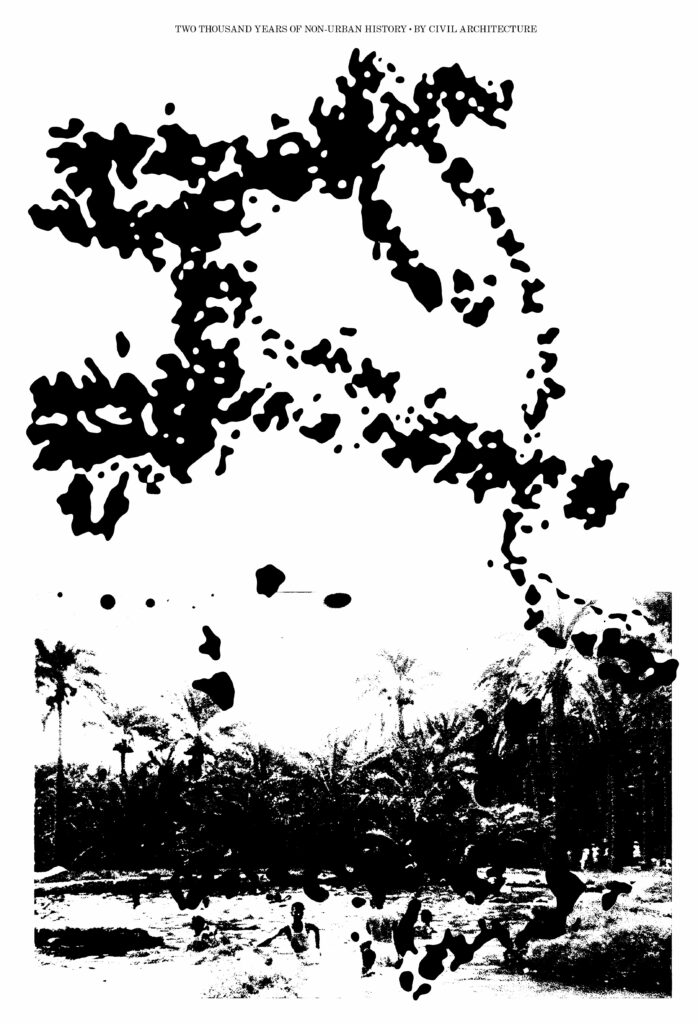
Two Thousand Years of Non-Urban History
<p>For the Oslo Architecture Triennale we presented three cases of “non-urban planning” in the Gulf countries. As instances that predate the aggregations of Gulf courtyard homes, this triptych spans several thousand years and consists of the desert kites, the water channels (qanat / aflaj) that fed agricultural areas, and the fish traps along the coast. These examples are instances where a series of applied forms are inscribed into, or constructed onto, the topography by a community. The lines cover kilometers of territory with the expressed aim of creating a collective infrastructure. These interventions, although different in location and function, are collectively a series of lines that cover kilometers of territory with the expressed aim at creating a cohesive infrastructure. In contrast to the laissez-faire practices of town making, these lines were drawn based on an a priori configuration, tested over thousands of years, with a shared set of cultural and political planning practices that governed their construction and use. Rules over planting, hunting, water distribution, and even the careful land subdivision reveal not an unplanned Gulf city, but rather a deliberate and painstaking application of planning as part of both formal and political processes. In this regard, the landscape of the Gulf is far more planned than its cities and, its social structures far more urban.</p>
Authors: Hamed Bukhamseen, Ali Ismail Karimi
Contributors: Fatima Nickahdar, Hanan Ashad, Jaffar Haddad, Alanood Alkhayat
Designer: Jannis Zell, Phil Zumbruch
Copy Editor: Jake Starmer
Photographer: Moath Alofi, Hussain Almosawi, Mariam Alarab, Camile Zakharia
Part of: Enough: The Architecture of Degrowth