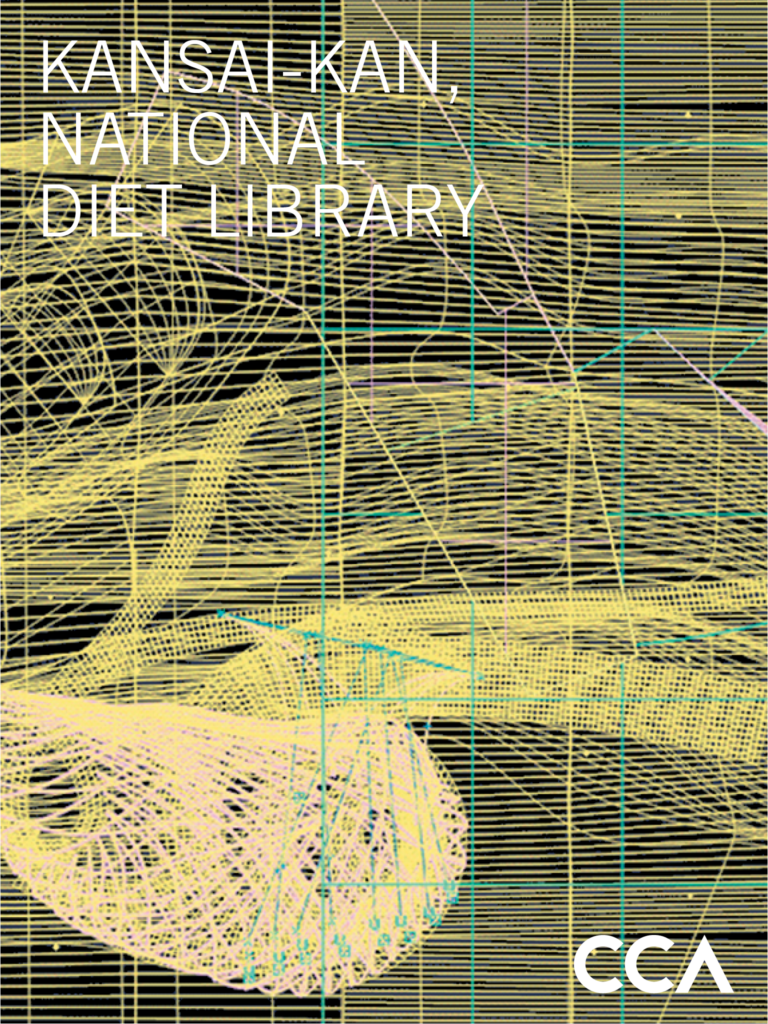
Kansai-kan, National Diet Library
<p>In this publication, Greg Lynn, Jesse Reiser, and Nanako Umemoto discuss RUR’s entry to the competition for the Kansai-kan, or Kansai branch, of the National Diet Library in Kyoto, a project that pairs an automated system for storing and retrieving library materials with a fluid landscape of public and research spaces distributed across three interconnected, sloping levels.</p> <p>RUR’s design, which was a finalist in the 1995 competition, fulfils the conventional program of a library—information storage and access—while addressing both the explosion of digital tectonics in surface modelling and new library technologies. The design process began with hand drawings and wax models; the most complicated segments of the project were then modelled in the computer, allowing control over the three-dimensional geometry of the library building’s continuous landscapes and complex components.</p> <p>The Kansai library marked the beginning of the integration of digital techniques for the firm, and exemplifies an approach to surface modelling and topological language that emerged in the mid-1990s. Through these techniques, the project proposes a new vein of public and social space that leverages the possibilities of information flows and their concentration at a specific site.</p> <p>As part of a multiyear project that includes three exhibitions on twenty-five seminal projects, the CCA and Greg Lynn are publishing a series of digital publications recording conversations with key architects. The epubs are heavily illustrated with photos, drawings, renderings, videos, PDFs, and interactive 3D models.</p>
Authors: Jesse Reiser, Nanako Umemoto
Editors: Greg Lynn
Editorial Coordination: Jayne Kelley
Media Coordination: Jayne Kelley, Jim Bell, Irene Chin
Design: Linked by Air
Transcription: Christiane Côté
Rights and Reproduction: Stéphane Aleixandre
Canadian Centre for Architecture
Part of: Archaeology of the Digital
ISBN: 978-1-927071-36-6