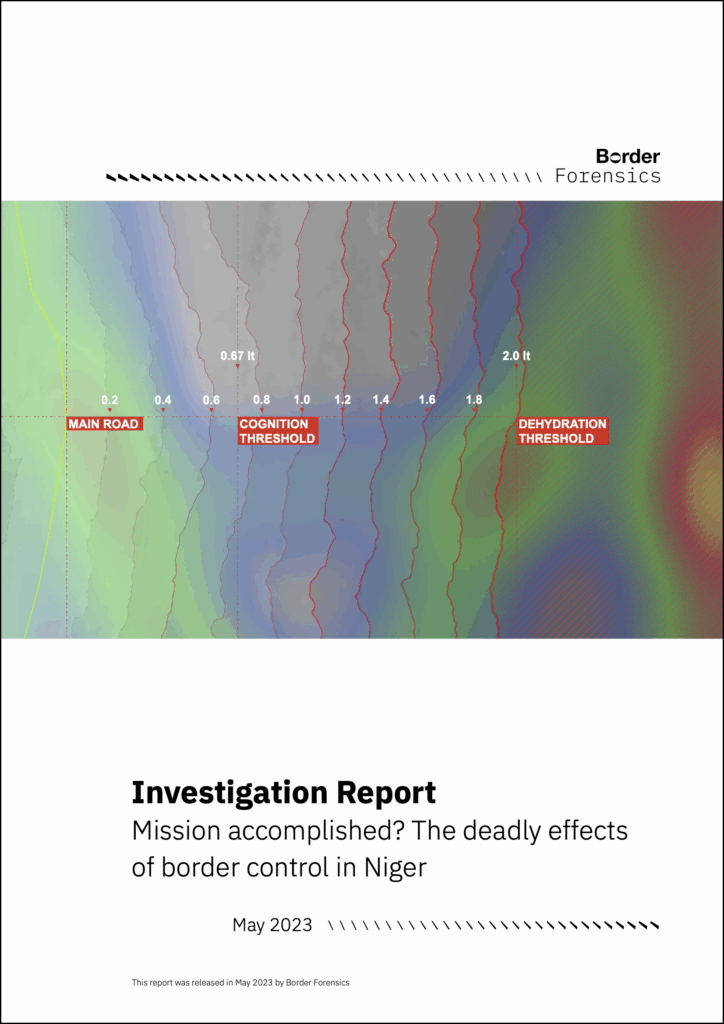
Mission Accomplished? The Deadly Effects Of Border Control In Niger
<p>On May 26, 2015, the Parliament of Niger adopted Law No. 2015-36 on Illegal Trafficking of Migrants, which resulted in a repressive and security-based approach to migration management. The law was drafted under the auspices of the United Nations Office on Drugs and Crime (UNODC), with financial support from Italy and Denmark.</p> <p>Migrant services providers (transporters, hosts, brokers, etc.) who had until then operated in broad daylight as part of a socially and economically essential cross-Saharan infrastructure of mobility, were suddenly criminalised and threatened by harsh penalties and imprisonment.</p> <p>New forms of border control were established, with the financial and technical support of EU institutions and Member States seeking to stem migration across the Sahara. In the years that have followed, thousands of incidents of migrant deaths and disappearances have been recorded in northern Niger. Transport drivers – now characterized as negligent and greedy smugglers – were blamed for the increase in deaths and disappearances by the Nigerien government and news media, as well EU agencies such as Frontex. As a result of its tough stance, Niger has been erected as a model in terms of “combating the illicit traffic of migrants.” The government of Niger and its international partners have developed a “<em>mission accomplished</em>” narrative, in which they boast about their success in curbing the number of “migrants” transiting through Niger and foreground the protection of migrants against smugglers.</p> <p>In this report, Border Forensics’ investigation mobilizes new and unique geo-spatial analysis and remote sensing methodologies to contribute to a better empirical analysis of the lethal effects of Law 2015-36 and the heightened border control it led to. We first detail the underlying context for the dramatic shifts in the approach to migration at the national level in Niger, and the role of European actors in developing Niger’s border controls from 2015 onwards to thwart migration to Europe. We further discuss the challenges of data collection that has limited the availability of empirical evidence documenting the effects of Law 2015-036. We then describe the unique methodologies we have developed and data sources we have accessed and in turn apply these methods to a multi-sited case study along a section of the Agadez-Sabha route stretching from the civilian town of Séguédine, through the military outpost of Madama, and up to the Toummo checkpoint at the Niger-Libya border. We provide a brief overview of each site before describing the remote sensing and geospatial analysis we conducted at each site. Finally, we discuss the implications of those findings for assigning accountability for the increased dangers of cross-Saharan travel in Niger in the wake of Law 2015-036.</p>
Authors: Charles Heller, Lorenzo Pezzani
Researcher: Rhoumour Ahmet Tchilouta, Tara Plath
Editors: Tara Plath, Giovanna Reder
Developer: Sam Chambers, Stanislas Michel, Rossana Padeletti, Jack Isles, Giovanna Reder
Designer: Jelka Kretzschmar
Translators: Isabelle Saint-Saëns, Mathilde Campergue, Rhoumour Ahmet Tchilouta
Copy Editor: Angela Smith